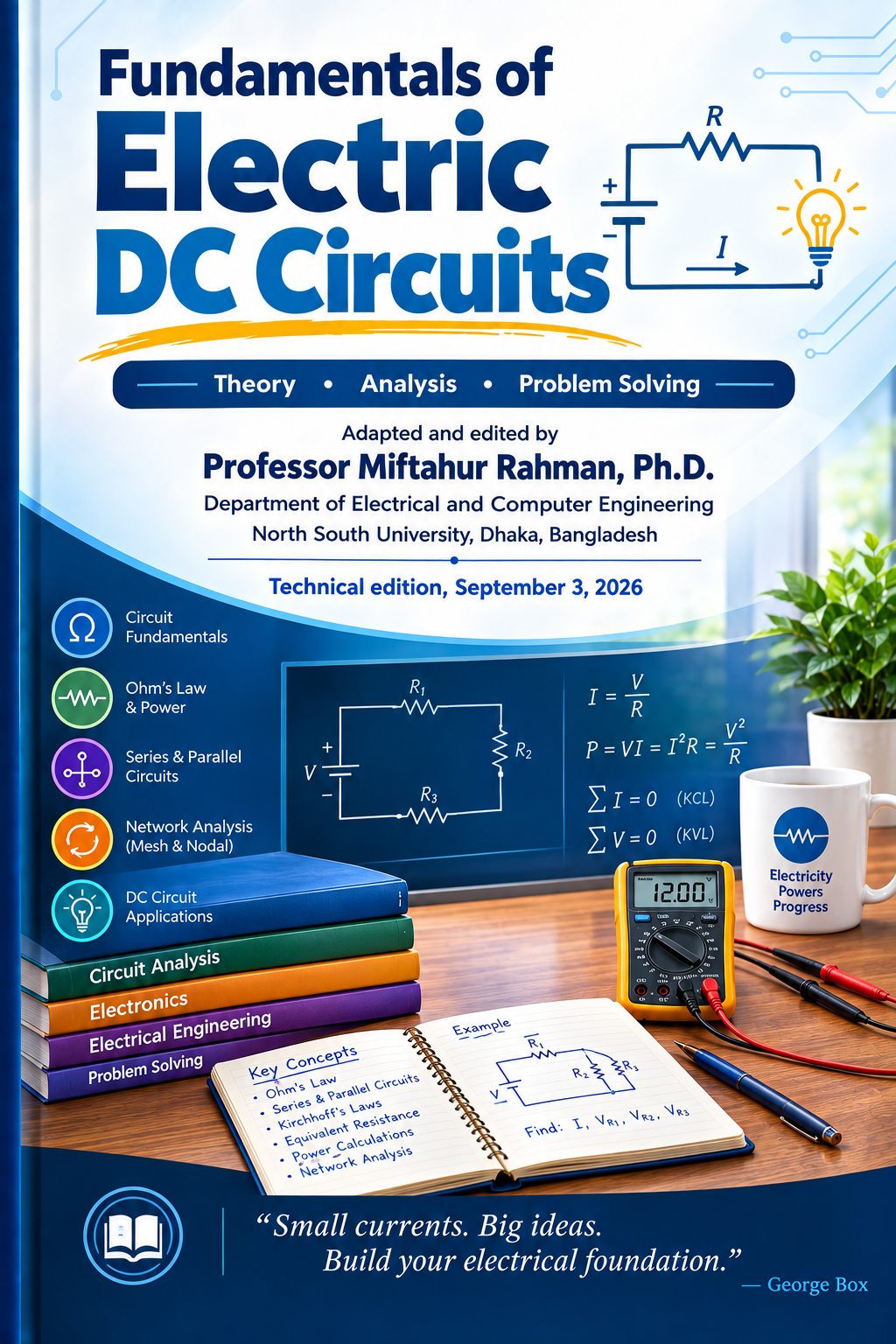
Fundamentals of Electric DC Circuits
Adapted from C. K. Alexander and M. N. O. Sadiku, Fundamentals of Electric Circuits.
Professor Miftahur Rahman, Ph.D.
Department of Electrical and Computer Engineering
North South University
Dhaka, Bangladesh
Published by IRays Teknology Ltd.
First Edition
Copyright
Copyright © IRays Teknology Ltd. All rights reserved.
No part of this publication may be reproduced, stored in a retrieval system, or transmitted in any form or by any means—electronic, mechanical, photocopying, recording, or otherwise—without the prior written permission of IRays Teknology Ltd.
The material in this book is adapted and reorganized from the lecture notes and problem sets of the course EEE141: Electrical Circuits I, Department of Electrical and Computer Engineering, North South University, which in turn draw upon the standard treatment in C. K. Alexander and M. N. O. Sadiku, Fundamentals of Electric Circuits. Circuit figures used in the homework problem sets are reproduced from the instructor’s course materials.
Author: Professor Miftahur Rahman, Ph.D.
Publisher: IRays Teknology Ltd.
Website: https://irays-teknology-ltd.com
This book is intended as a learning resource for undergraduate students of electrical and computer engineering. While every effort has been made to ensure the accuracy of the content, the author and publisher assume no responsibility for errors or omissions.
About the Author
Professor Miftahur Rahman, Ph.D. is a faculty member in the Department of Electrical and Computer Engineering (ECE) at North South University, Dhaka, Bangladesh. He teaches undergraduate courses in electric circuit theory, electronics, and related areas, including EEE141: Electrical Circuits I. His teaching emphasizes rigorous first principles, careful derivations, and extensive worked examples that bridge theory and practice.
This book grew out of his lecture slides, homework assignments, and classroom experience in teaching the fundamentals of direct-current (DC) circuit analysis.
Preface
This book, Fundamentals of Electric DC Circuits, is a focused, self-contained treatment of the direct-current (DC) portion of electric circuit theory. It is designed for a first course in electric circuits—typically the opening of an undergraduate electrical and computer engineering program—and it develops the subject from first principles through the powerful general methods and theorems that practicing engineers use daily.
The book is adapted and reorganized from my lecture materials for EEE141: Electrical Circuits I at North South University, which in turn follow the standard and widely used presentation of C. K. Alexander and M. N. O. Sadiku in Fundamentals of Electric Circuits. The scope is deliberately limited to DC circuits: charge, current, voltage, power, and energy; Ohm’s law and Kirchhoff’s laws; series and parallel combinations and voltage/current division; nodal and mesh analysis; the circuit theorems of linearity, superposition, source transformation, Thévenin, Norton, and maximum power transfer; and finally the energy-storage elements—capacitors and inductors—together with the transient response of first- and second-order DC circuits.
How this book is organized
- Chapter 1 — Basic Concepts establishes the physical and mathematical foundation: the SI system, electric charge and current, voltage, power and energy, the passive sign convention, and independent and dependent sources.
- Chapter 2 — Basic Laws introduces Ohm’s law, resistance and conductance, nodes/branches/loops, Kirchhoff’s current and voltage laws, series and parallel resistor combinations, voltage and current division, and the wye–delta transformations.
- Chapter 3 — Methods of Analysis presents the two systematic general methods—nodal analysis (based on KCL) and mesh analysis (based on KVL)—including the supernode and supermesh techniques and the use of Cramer’s rule to solve the resulting simultaneous equations.
- Chapter 4 — Circuit Theorems develops linearity, superposition, source transformation, Thévenin’s and Norton’s theorems, and maximum power transfer, showing how large linear circuits can be reduced to simple equivalents.
- Chapter 5 — Capacitors, Inductors, and DC Transients introduces the two energy-storage elements, their series and parallel combinations, their behavior under DC steady-state conditions, and the natural and step responses of first-order (RC and RL) and second-order (RLC) circuits.
Pedagogical features
Each chapter opens with a set of Learning Objectives and closes with a Key Points summary. Within the chapter, theory is developed with full derivations, followed by numbered Examples that are worked completely step by step, and Practice Problems (each with a full solution) so that students can immediately test their understanding. At the end of every chapter is a set of Homework Problems taken directly from my course assignments; these are given without solutions, but each is accompanied by a one-line Hint to point the student toward the right method or first step. Circuit figures for the homework problems are reproduced from the course materials, while the figures within the body of each chapter are clean schematic placeholders that I will replace with my own figures in a future edition.
A note to the student
Circuit analysis is a skill built by doing. Read the theory, then work every example by hand before reading its solution. Attempt the practice problems and the homework problems yourself, using the hints only when you are stuck. Always carry your units through every calculation and check that power balances (total supplied equals total absorbed). These habits will serve you well not only in this course but throughout your engineering career.
— Professor Miftahur Rahman, Ph.D.
Department of ECE, North South University
List of Symbols and SI Units
| Symbol | Quantity | SI Unit | Unit Symbol |
|---|---|---|---|
| \(q\) | Electric charge | coulomb | C |
| \(i, I\) | Electric current | ampere | A |
| \(v, V\) | Voltage (potential difference) | volt | V |
| \(p, P\) | Power | watt | W |
| \(w, W\) | Energy | joule | J |
| \(R\) | Resistance | ohm | \(\Omega\) |
| \(G\) | Conductance | siemens | S |
| \(\rho\) | Resistivity | ohm-meter | \(\Omega\cdot\text{m}\) |
| \(C\) | Capacitance | farad | F |
| \(L\) | Inductance | henry | H |
| \(\tau\) | Time constant | second | s |
| \(t\) | Time | second | s |
| \(e\) | Elementary charge | \(1.602\times10^{-19}\) C | — |
SI prefixes
| Prefix | Symbol | Factor | Prefix | Symbol | Factor |
|---|---|---|---|---|---|
| tera | T | \(10^{12}\) | centi | c | \(10^{-2}\) |
| giga | G | \(10^{9}\) | milli | m | \(10^{-3}\) |
| mega | M | \(10^{6}\) | micro | \(\mu\) | \(10^{-6}\) |
| kilo | k | \(10^{3}\) | nano | n | \(10^{-9}\) |
| hecto | h | \(10^{2}\) | pico | p | \(10^{-12}\) |
| deka | da | \(10^{1}\) | femto | f | \(10^{-15}\) |
Standard numerical constants
- Elementary charge: \(e = 1.602\times10^{-19}\ \text{C}\)
- \(1\ \text{W} = 1\ \text{J/s} = 1\ \text{V}\cdot\text{A}\)
- \(1\ \text{V} = 1\ \text{J/C}\)
- \(1\ \text{A} = 1\ \text{C/s}\)
- \(1\ \text{Wh} = 3600\ \text{J}\)
- \(1\ \text{kWh} = 3.6\times10^{6}\ \text{J}\)
Table of Contents
- Chapter 1 — Basic Concepts
- Chapter 2 — Basic Laws
- Chapter 3 — Methods of Analysis
- Chapter 4 — Circuit Theorems
- Chapter 5 — Capacitors, Inductors, and DC Transients
- Appendix A — Simultaneous Equations, Matrix Inversion, and Cramer’s Rule
- Appendix B — Quick-Reference Formula Sheet
- Index